Why Banking Rules Could Change the Economics of C&I Solar
Tighter banking rules, like Maharashtra's same-slot banking, can change how much solar a C&I business can actually use. Here's what to evaluate beyond the tariff.
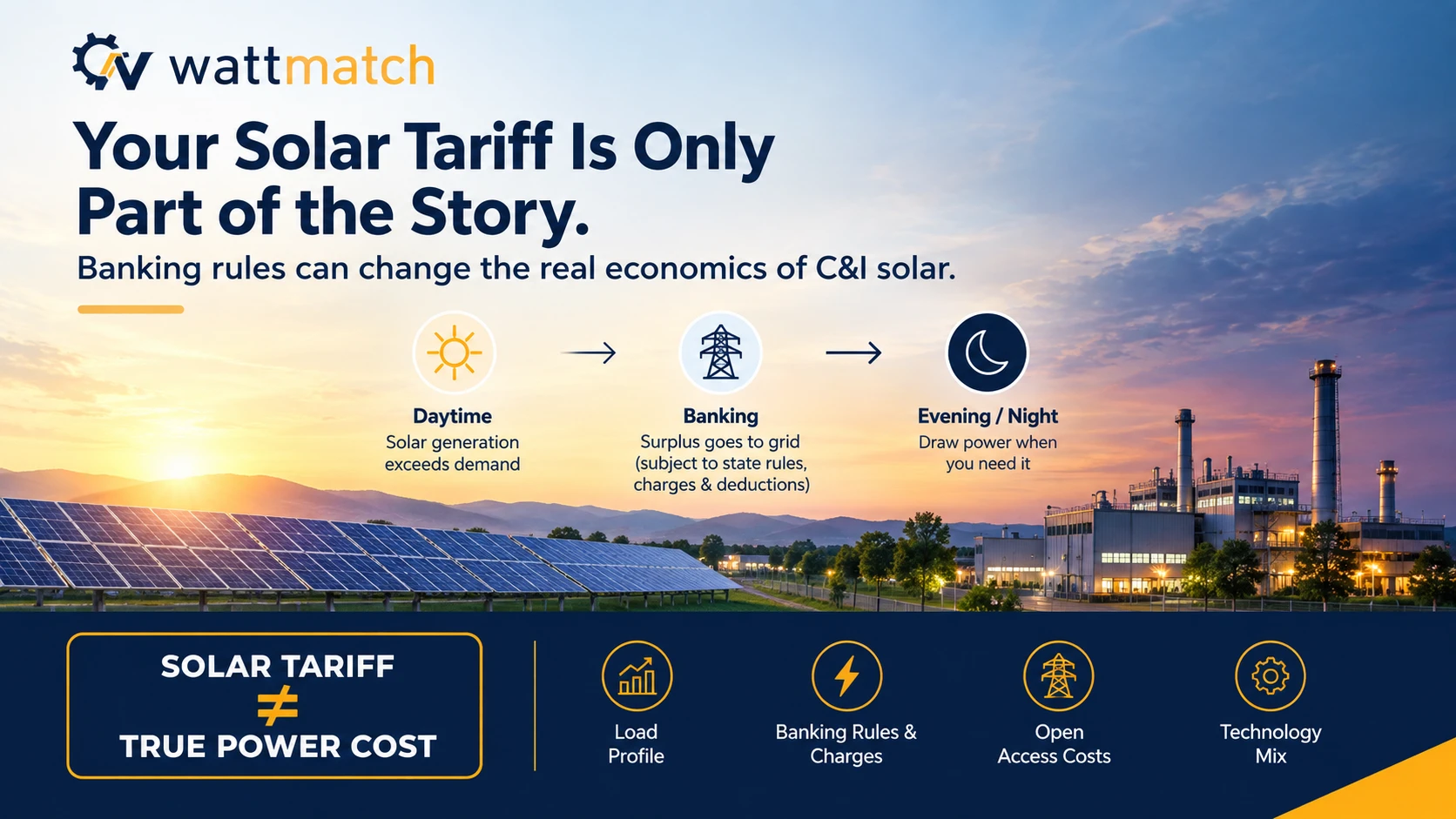
For years, one of the biggest advantages of solar power for commercial and industrial (C&I) businesses has been the ability to generate renewable electricity during the day, use what is needed immediately, and bank surplus power for later consumption.
For a factory that operates beyond daylight hours, banking can make solar power look far more attractive than its generation profile would suggest.
But that equation is changing.
Across Indian states, regulators are increasingly tightening the rules around how renewable energy can be banked, when banked electricity can be drawn, and what charges or deductions apply. Maharashtra, for example, introduced same-slot banking in 2025, restricting drawal to the same time slot in which electricity was banked.
For C&I businesses evaluating a 15–25 year renewable energy contract, this is more than a regulatory detail. Banking rules can directly change the amount of renewable power a business can actually use, the effective landed cost of that power, and ultimately which renewable energy structure makes financial sense.
The question is no longer simply:
"What is the solar tariff?"
It is:
"How much of that solar generation can actually be matched with my load, under the banking rules that apply to me?"
1. What is banking in renewable energy?
Solar generation and industrial electricity consumption rarely occur at exactly the same time.
A solar plant generates most of its electricity during daylight hours. But a factory may have:
- Day shifts
- Evening shifts
- Multiple shifts
- 24/7 operations
- Weekend or seasonal variations
This creates a mismatch between when renewable electricity is generated and when the C&I consumer needs it.
Banking was designed to help bridge that gap.
In simple terms, surplus renewable electricity generated at one point can be injected into the grid and an equivalent amount can be drawn later, subject to the state's applicable rules, charges and deductions.
The WattMatch knowledge base defines banking as:
"Exporting surplus generation and drawing back an equivalent amount later, subject to state rules and charges."
For example, imagine a factory's solar plant generates 1,000 units between 10 AM and 4 PM, while the factory only consumes 700 units during those hours.
The remaining 300 units can potentially be banked and used later.
That mechanism can make a solar-only project much more compatible with a load that extends into the evening.
But banking is not the same as having a battery.
The grid is effectively providing a regulatory settlement mechanism, rather than physically storing those 300 units for the customer.
And that distinction is becoming increasingly important.
2. Why banking rules matter to the economics of solar
A solar tariff is usually quoted on a per-unit basis.
But the real economics of renewable power depend on how many of those generated units actually become useful units for the C&I consumer.
Consider a simplified example.
A solar project produces 100 units.
If the buyer can effectively use 90 of those units through direct consumption and banking, the economics can be attractive.
But if regulatory restrictions mean only 75 units can effectively be utilised, the economics change.
The buyer is still paying for the underlying renewable generation, but a smaller portion of that generation is translating into useful consumption.
This is why utilisation of renewable generation can be just as important as the headline generation tariff.
The WattMatch knowledge base already makes this broader point: a generator's quoted tariff is only one component of the customer's actual landed cost. Wheeling, transmission, CSS, AS and banking charges can all affect the final economics, and these vary significantly by state.
Banking therefore needs to be treated as part of the commercial model—not as an administrative afterthought.
3. The biggest issue: banking rules are not uniform across India
There is no single banking framework that applies identically to every C&I consumer.
India's power sector is highly state-specific.
State Electricity Regulatory Commissions determine important aspects of open access, including charges, procedures and banking arrangements. The rules can therefore differ substantially between states.
As the WattMatch knowledge base notes, every major open access charge, along with banking rules and approval timelines, is determined at the state level.
This creates an important consequence for C&I businesses:
A solar project that works extremely well in one state may not produce the same economics in another.
Two factories with identical load profiles and identical solar tariffs can therefore have very different renewable energy economics simply because they are located in different regulatory environments.
That is why comparing renewable energy offers purely on ₹/unit can be misleading.
4. Same-slot banking changes the equation
One of the clearest examples of how banking rules can affect project economics is Maharashtra.
The state introduced same-slot banking in 2025, restricting the drawal of banked electricity to the same time slot in which it was banked. According to the WattMatch knowledge base, this effectively removed the ability to use banking as the broad day-to-night balancing mechanism that solar-only consumers had previously relied upon.
Why does this matter?
Consider a factory that consumes electricity throughout the day and evening.
Under a more flexible banking arrangement:
Daytime solar generation → surplus banked → evening consumption
Under a same-slot mechanism, that flexibility is significantly reduced.
The factory can no longer assume that surplus solar generated at one time can simply be carried forward and used whenever the factory needs it.
That means the project's economics become much more dependent on the actual overlap between solar generation and the factory's load profile.
And this is where many C&I renewable energy evaluations need to become more sophisticated.
5. Your load profile matters more than your monthly consumption
A common mistake is to start a renewable energy evaluation with:
"The factory consumes 10 million units a year."
That is useful information—but it is not enough.
Two factories can both consume 10 million units annually and have completely different renewable energy requirements.
Factory A: Day-heavy load
- 70–80% of consumption occurs during daylight
- One or two shifts
- Limited evening operations
Solar generation naturally overlaps with consumption.
Factory B: Round-the-clock load
- Three shifts
- Significant night-time consumption
- Limited daytime shutdown
- Continuous production process
Solar generation and consumption are much less aligned.
If banking becomes restrictive, Factory A may continue to find solar highly attractive, while Factory B may need to consider a different technology mix.
This is why load profile is becoming as important as annual energy consumption when designing a C&I renewable energy strategy.
6. Banking can make solar-only projects less attractive for some consumers
Solar remains one of the most mature and cost-effective renewable technologies available to C&I businesses.
But solar has an inherent limitation: it only generates during daylight hours.
Indian solar plants typically operate at around 19–22% CUF, meaning their annual output is significantly lower than what the same capacity would produce if it ran continuously.
Historically, banking helped address part of this problem.
If a consumer could bank surplus daytime generation and draw it later, solar could serve a larger portion of a customer's overall consumption.
But if banking becomes more restrictive, the customer may need to find other ways to match renewable generation with consumption.
This does not mean solar stops making economic sense.
It means the optimal solution may move from:
Solar + banking
towards:
Solar + wind
or:
Solar + BESS
or, for certain requirements:
Solar + wind + BESS / FDRE
7. This is where hybrid renewable projects become more important
Solar and wind have different generation patterns.
Solar is concentrated during daylight hours.
Wind generation can complement solar, particularly during periods when solar production is low, although the exact generation profile is highly dependent on location.
A solar-wind hybrid project can therefore provide a more balanced generation profile than solar alone.
The WattMatch knowledge base notes that hybrid projects can smooth the generation curve without relying entirely on battery storage, with industry practitioners in Tamil Nadu reporting hybrid open access being capable of meeting a significant share of large C&I requirements.
For a C&I consumer affected by tighter banking rules, this can be important.
Instead of relying on regulatory banking to move solar generation from one period to another, the generation portfolio itself can be designed to produce power across a broader range of hours.
8. BESS changes the conversation completely
Battery Energy Storage Systems take the concept one step further.
Instead of relying on the grid and regulatory banking to shift electricity across time, a BESS can physically store electricity and discharge it when the consumer needs it.
For example:
Afternoon
Solar generates surplus electricity → BESS charges
Evening
Solar generation falls → BESS discharges
Night
The consumer continues receiving power from the available renewable-plus-storage system, subject to project design.
This is fundamentally different from banking.
Banking is a regulatory settlement mechanism.
BESS is a physical storage asset.
That distinction becomes increasingly valuable as banking arrangements become less flexible.
The WattMatch knowledge base describes solar + storage and FDRE as the structure capable of offering genuinely dispatchable renewable power beyond solar generation hours.
9. But storage does not automatically mean higher economics
There is an important commercial caveat.
Adding a BESS introduces another asset, another capital cost and another layer of project complexity.
So a C&I buyer should not automatically conclude:
"Banking is getting tighter, so we need batteries."
The right question is:
"What is the least-cost renewable configuration that can reliably meet our actual load profile?"
For some businesses, the answer may still be solar.
For others, it could be solar + wind.
For a 24/7 operation, solar + BESS or FDRE may make more sense.
And for some consumers, a combination of rooftop solar, open access and storage could provide the most practical solution.
The technology should follow the load profile—not the other way around.
10. Banking charges also affect landed cost
Banking isn't necessarily free.
The open access charge stack can include a banking charge or an in-kind deduction for banked units.
The WattMatch reference range puts banking charges at approximately 2–6% of banked units, although actual charges vary by state and regulatory order.
That means a buyer evaluating a renewable PPA needs to ask:
- How much electricity is expected to be banked?
- What percentage of banked electricity is deducted?
- When can banked electricity be drawn?
- Does banking expire?
- Is banking allowed across all relevant time periods?
- What happens to unused banked energy?
- Can the rules change during a 15–25 year PPA?
These questions can materially change the project's effective cost.
11. The hidden risk in a 20-year PPA
This is perhaps the most important point for a C&I buyer.
A renewable energy PPA can run for 15–25 years.
But the regulatory environment around that PPA can change during the contract.
The tariff may be fixed, but the surrounding charge and regulatory framework may not be.
For example, a project that looks attractive today could face a different banking regime several years into its operating life.
That means a C&I buyer should not evaluate a long-term renewable PPA solely on today's tariff.
The evaluation should consider:
Generation tariff + transmission + wheeling + surcharges + banking + losses + utilisation + regulatory risk
The WattMatch knowledge base explicitly cautions that state-level charges and rules should be checked before quoting specific landed costs because they can change meaningfully between markets.
12. Banking risk should be evaluated alongside the load profile
A useful way for a C&I business to approach the decision is to ask four questions.
1. When do we consume electricity?
Map consumption hour by hour rather than looking only at annual or monthly totals.
2. How much solar generation overlaps with our consumption?
The higher the overlap, the less dependent the business is on banking.
3. How much surplus will need to be banked?
A project that relies heavily on banking is more exposed to changes in banking rules.
4. What happens if banking becomes less flexible?
Model the economics under multiple scenarios.
For example:
- Scenario A: Current banking rules
- Scenario B: Higher banking charges
- Scenario C: Restricted banking windows
- Scenario D: Minimal banking availability
If the project only works under Scenario A, it may not be sufficiently resilient for a 15–25 year contract.
13. What this means for generators
The change in banking economics is not just a buyer-side issue.
It also changes what C&I buyers will demand from renewable energy generators.
Historically, a generator could focus heavily on:
- Tariff
- Plant location
- Capacity
- Expected CUF
Increasingly, buyers may ask about:
- Generation profile
- Hourly matching
- Hybridisation
- Storage
- Firm power
- Forecasting
- State-specific banking exposure
- Long-term regulatory resilience
This creates an opportunity for generators that can offer more than low-cost solar.
A developer capable of offering solar + wind, storage-backed power or a carefully structured hybrid solution may be able to address a much broader range of C&I demand.
14. Why this makes price discovery even more important
As renewable energy solutions become more complex, comparing offers becomes harder.
A ₹3.50/unit solar offer is not necessarily better than a ₹4/unit hybrid offer.
The cheaper tariff may come with:
- Greater dependence on banking
- Lower generation availability
- Higher balancing requirements
- More exposure to state-level charges
- Greater mismatch with the customer's load profile
Conversely, a slightly higher tariff could potentially deliver a more usable and predictable renewable supply.
This is why C&I renewable procurement should move from tariff comparison to total-value comparison.
The right question is not:
"Who is offering the lowest tariff?"
It is:
"Which structure delivers the lowest reliable cost for the electricity our business actually needs?"
15. Where WattMatch fits into this changing market
Banking rules are a good example of why C&I renewable procurement is becoming too complex to reduce to a simple generator quote.
The WattMatch model is designed to help buyers compare renewable energy options across generators while accounting for the broader project structure.
The platform's role includes competitive price discovery, generator technical and financial vetting, standardised contracting and ongoing relationship and regulatory management.
For a buyer, this means the evaluation can move beyond:
"Which generator quoted the lowest ₹/unit?"
towards:
"Which renewable structure works best for this load, in this state, under the applicable regulatory framework?"
That distinction becomes increasingly important as banking rules evolve.
16. The bigger shift: from cheap renewable energy to usable renewable energy
India's C&I renewable market is entering a phase where simply adding more solar capacity is no longer the entire challenge.
The next question is:
How do you make renewable generation available when the customer actually needs it?
Banking was one answer.
Hybrid generation is another.
Battery storage is another.
Better load matching is another.
The most effective solution will depend on the individual consumer.
For a daylight-heavy factory, solar may remain the obvious choice.
For a multi-shift industrial plant, solar plus wind may provide better utilisation.
For a round-the-clock operation, storage-backed renewable energy may increasingly become necessary.
And for many businesses, a combination of these approaches may ultimately be the most economical.