Group Captive Solar Scheme in India: 26% & 51% Rules for C&I Buyers
Understand group captive solar in India, including the 26% ownership and 51% consumption requirements, captive vs open access, landed cost and key checks for C&I buyers.
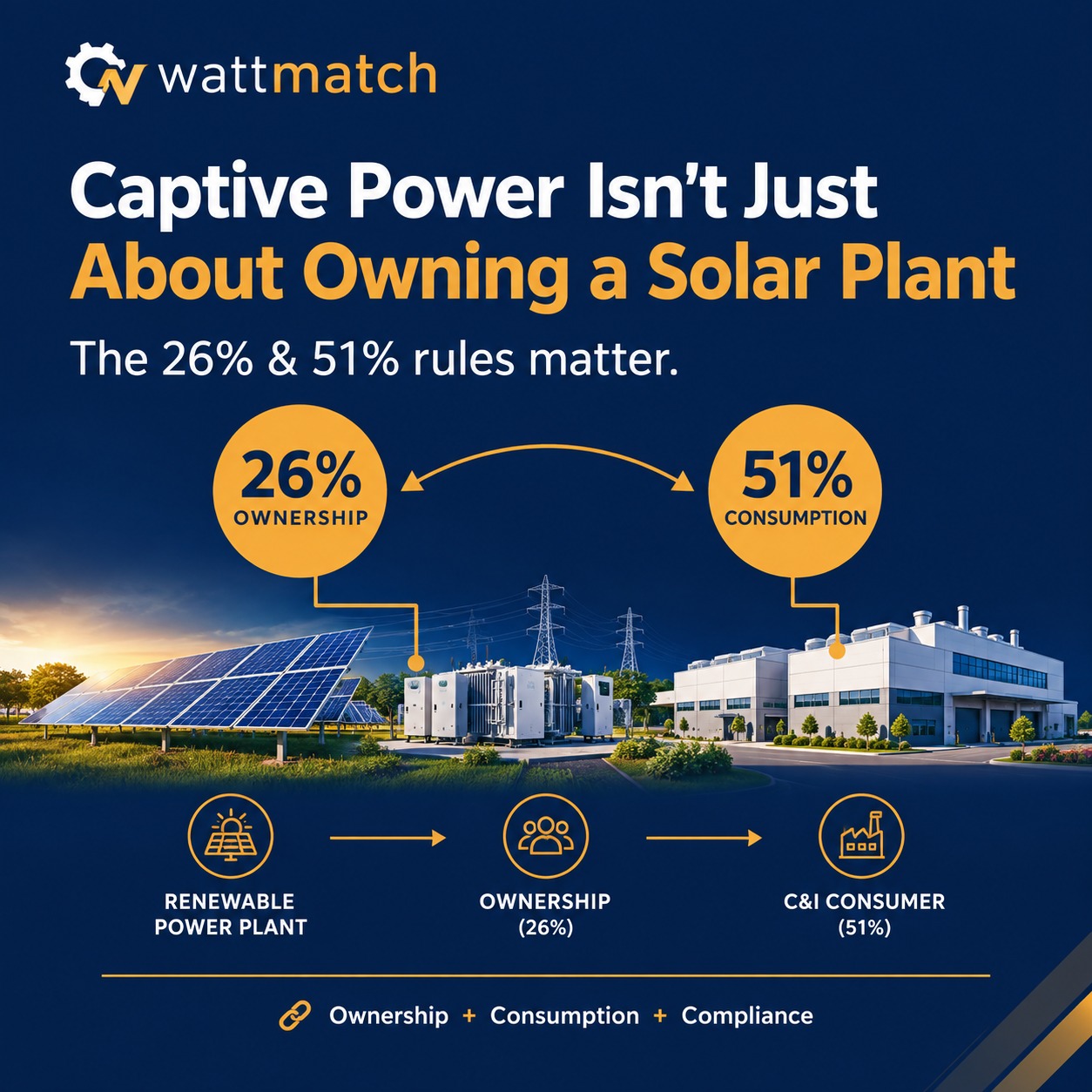
For a C&I business exploring renewable energy procurement in India, captive power can look deceptively simple.
Buy a share in a renewable energy project. Use the electricity generated. Reduce your exposure to certain open access charges.
But a captive solar power project is not simply an investment in a solar plant.
The economics of captive and group captive solar schemes in India depend on meeting specific ownership, consumption and regulatory requirements throughout the project lifecycle.
Two numbers are particularly important:
26% ownership and 51% consumption
These are not simply investment thresholds. They form part of the framework used to determine whether a generating project qualifies as captive and whether captive users can receive the applicable regulatory treatment, including exemption from certain open access surcharges where eligible.
For a C&I business considering a 15–25 year renewable power purchase agreement (PPA), understanding these requirements is critical.
The real question is not:
"Can we buy 26% of a solar project?"
It is:
"Can our ownership, electricity consumption and project structure remain compliant throughout the life of the arrangement?"
This guide explains how captive and group captive renewable power works, how the 26% and 51% requirements fit together, how captive compares with third-party open access, and what C&I buyers should evaluate before committing capital.
Quick Answer: What Do the 26% and 51% Rules Mean?
At a high level:
| Requirement | What it relates to | Why it matters |
|---|---|---|
| 26% | Ownership | Captive users need to meet the applicable ownership requirement in the generating plant |
| 51% | Consumption | Captive users need to meet the applicable minimum captive consumption requirement |
| Both | Overall structure | Meeting only one requirement is not enough |
The exact regulatory treatment depends on the applicable rules and project structure, so C&I buyers should verify the current requirements before entering into a captive or group captive arrangement.
The important point is that ownership and consumption have to work together.
1. What Is Captive Solar Power?
In a conventional third-party open access arrangement, a C&I business purchases renewable electricity from a generator without owning the generating asset.
The relationship broadly looks like:
Generator → Renewable Power Plant → Grid → C&I Buyer
The buyer pays for electricity generated by someone else's project.
A captive arrangement is different.
The consumer has an ownership interest in the generating plant and uses electricity generated by that plant.
The structure becomes:
C&I Consumer → Ownership in Project → Renewable Power Plant → Grid → C&I Consumer
The ownership can be held by a single consumer or shared among multiple consumers through a group captive renewable energy structure.
This is why captive power should not be viewed simply as another type of solar PPA.
It combines:
- Renewable energy procurement
- Project ownership
- Electricity consumption
- Open access
- Regulatory compliance
- Long-term financial commitment
The potential economic benefit comes partly from the regulatory treatment available to qualifying captive consumption, including applicable exemptions from certain surcharges.
For C&I businesses comparing open access solar vs captive solar, this distinction is important.
2. What Is a Group Captive Solar Scheme in India?
A group captive solar project allows multiple C&I consumers to collectively participate in the ownership of a renewable generating project.
Instead of one industrial consumer developing and owning an entire solar project, several businesses can participate in the same project through an appropriate ownership structure.
For example:
Solar Developer + C&I Consumer A + C&I Consumer B + C&I Consumer C
can participate in a common renewable energy project, with ownership and electricity consumption structured according to the applicable captive framework.
This can make renewable power procurement more accessible to businesses that:
- Have substantial electricity consumption
- Want long-term renewable power
- Do not want to develop an entire project independently
- Are willing to commit capital
- Want to evaluate the economics of captive consumption
However, group captive also introduces additional complexity.
Each participant's:
Ownership + Consumption + Eligibility + Compliance
needs to be considered.
3. The 26% Ownership Requirement
The first number every C&I buyer considering captive power should understand is 26%.
The applicable captive framework requires captive users to meet the relevant ownership requirement in the generating plant.
This establishes that the consumer has a genuine ownership interest rather than simply purchasing electricity through a contract labelled as captive.
For a C&I business, this can mean committing capital to the project and accepting the associated ownership and governance arrangements.
That makes captive fundamentally different from a conventional third-party solar PPA.
Before investing, a buyer should understand:
- How much equity is required?
- When does the investment need to be made?
- Who owns the generating company?
- What percentage of the project will the buyer own?
- What rights come with the ownership?
- How is ownership transferred?
- What happens if the buyer exits?
- How are future capital requirements handled?
Captive power is therefore not simply a tariff arrangement.
It is also an investment structure.
4. The 51% Consumption Requirement
Ownership alone is not enough.
The second major number is 51% consumption.
Under the applicable captive framework, captive users need to consume the required proportion of the electricity generated by the project for captive consumption.
This is why project sizing is so important.
Imagine a renewable project generates 100 million units in a year.
If the applicable captive requirement requires 51% consumption, the relevant captive users need to meet the required consumption threshold.
That means a buyer cannot simply select a very large solar project because its quoted tariff appears attractive.
The project needs to be evaluated against:
- Annual electricity consumption
- Load profile
- Expected solar generation
- CUF
- Project capacity
- Ownership allocation
- Other captive consumers
- Expected future electricity demand
The key relationship is:
Plant Capacity → Generation → Ownership → Consumption
5. Why 26% Ownership and 51% Consumption Must Be Considered Together
This is where captive solar procurement becomes more complicated than it initially appears.
Consider a group captive project with several C&I consumers.
Each participant may have a defined ownership percentage.
The project generates electricity.
The participating consumers consume electricity from that project.
The ownership and consumption structure must satisfy the applicable captive requirements.
Therefore, the buyer should not ask only:
"How much equity are we buying?"
The more important question is:
"How much of the project's generation will we actually consume, and does the overall structure remain compliant?"
This becomes particularly important when multiple factories, manufacturing units or commercial facilities participate in the same group captive solar project.
6. Why Project Sizing Matters in Captive Renewable Energy
One of the biggest mistakes in evaluating captive renewable energy is looking only at MW capacity.
Suppose a factory consumes 20 million units of electricity annually.
A developer proposes a renewable project capable of generating substantially more electricity.
The initial reaction might be:
"More renewable capacity means more renewable energy."
But captive economics does not work that simply.
The project needs to be considered against the buyer's actual electricity consumption.
A C&I buyer should evaluate:
- Annual MWh consumption
- Monthly consumption
- Hourly or time-block load profile
- Expected generation
- Solar CUF
- Wind CUF, where applicable
- Banking requirements
- Transmission and wheeling losses
- Other captive participants
- Ownership allocation
- Future changes in demand
This is why:
MW capacity should never be considered in isolation from MWh consumption.
7. How CUF Affects Captive Solar Economics
Capacity Utilisation Factor (CUF) is important when evaluating a solar project because installed capacity does not represent actual annual electricity generation.
A 10 MW solar project does not generate:
10 MW × 24 hours × 365 days
because solar generation varies throughout the day and year.
The expected annual generation depends on the project's location, technology, resource availability, losses and CUF.
Therefore, a C&I buyer evaluating a captive solar power project needs to understand expected annual generation rather than looking only at the project's MW capacity.
The relationship is:
Installed Capacity → Expected Generation → Captive Consumption Requirement
A change in expected generation can affect the amount of electricity captive consumers need to consume to maintain compliance.
8. Why Can Captive Power Be Cheaper Than Third-Party Open Access?
This is one of the main reasons C&I businesses consider captive and group captive renewable energy.
In a third-party open access arrangement, the buyer may be exposed to charges such as:
- Wheeling charges
- Transmission charges
- Cross-Subsidy Surcharge (CSS)
- Additional Surcharge (AS)
- Banking charges
- Transmission and distribution losses
- Other applicable regulatory charges
For qualifying captive consumption, applicable exemptions from CSS and AS can materially change the economics.
This means a captive solar PPA cannot be evaluated simply by comparing the generation tariff with a third-party PPA tariff.
The buyer needs to compare the landed cost of renewable electricity. For example:
Generation Tariff + Transmission Charges + Wheeling Charges + Banking + Losses + Other Applicable Charges − Applicable Exemptions/Benefits = Landed Renewable Power Cost
This is the number that should ultimately be compared with the buyer's existing electricity cost.
9. Captive Does Not Mean "No Open Access Charges"
A common misconception is:
"If we go captive, we don't pay open access charges."
That is not correct.
Depending on the state, project structure and applicable regulations, captive users can still face costs such as:
- Transmission charges
- Wheeling charges
- Banking charges
- Losses
- Other applicable regulatory charges
The major economic advantage may come from exemption from CSS and AS, where the captive structure qualifies.
So the calculation is not:
Captive = No Charges
It is:
Captive = Potentially Lower Charge Burden Because Certain Surcharges May Not Apply
That distinction is critical when a CFO evaluates captive vs open access solar.
10. What Happens If the 51% Requirement Is Not Met?
Captive compliance is not necessarily a one-time exercise completed when the project starts.
The buyer needs to consider whether the required ownership and consumption conditions can be maintained over time.
If the applicable captive consumption requirement is not satisfied, the regulatory treatment of the project can be affected.
This can have a significant financial impact if the project's economics depend on exemptions from applicable surcharges.
For example, a project may initially appear attractive because of the expected reduction in CSS and AS exposure.
If the relevant exemption is lost, the landed cost of renewable electricity could increase.
Therefore:
Captive compliance should be treated as an ongoing obligation, not a commissioning-day checkbox.
11. What Can Cause C&I Electricity Consumption to Fall?
This is especially important for industrial and manufacturing businesses.
Electricity consumption can change because of:
- Production slowdown
- Temporary shutdown
- Plant expansion or contraction
- Energy-efficiency improvements
- Relocation
- Changes in operating shifts
- Business restructuring
- Acquisition or divestment
A factory that comfortably met its consumption requirements at the beginning of a long-term agreement may have a very different electricity demand profile several years later.
This raises an important question before signing a captive renewable energy agreement:
What happens if our electricity consumption falls significantly during the PPA term?
A robust captive structure should consider this scenario from the beginning.
12. Group Captive Adds Another Layer of Complexity
In a group captive solar project, several C&I consumers participate in the same generating project.
One participant's business decisions can potentially affect the broader structure.
For example, a participant may:
- Shut down a facility
- Reduce electricity consumption
- Exit the arrangement
- Sell its business
- Change its electricity requirements
The remaining participants may then need to evaluate how the ownership and consumption structure is affected.
This is why governance is important in a group captive solar scheme.
Before entering the project, buyers should understand:
- Who the other participants are
- How ownership is allocated
- How participants enter and exit
- What happens if a participant defaults
- How replacement participants are brought in
- How captive compliance is monitored
A group captive project should not depend on every participant behaving exactly as expected for 20 years without a contingency mechanism.
13. Captive vs Third-Party Open Access Solar
For a C&I buyer, the choice is not simply between two tariff numbers.
It is a comparison between two different procurement structures.
| Factor | Third-Party Open Access | Captive / Group Captive |
|---|---|---|
| Project ownership | Not required | Qualifying ownership required |
| Capital investment | Generally lower | Higher |
| CSS exposure | Generally applicable | Exemption may apply if qualifying |
| AS exposure | Generally applicable | Exemption may apply if qualifying |
| Structure | Relatively simpler | More complex |
| Compliance | Contractual + regulatory | Contractual + captive compliance |
| Governance | Relatively simpler | More important |
| Exit | Generally more flexible | Can be more complicated |
| Potential economics | Attractive | Potentially deeper savings |
| Suitable for | Buyers prioritising simplicity | Buyers willing to take ownership exposure |
The right structure depends on the buyer's:
Load + Capital Availability + Risk Appetite + Time Horizon + Renewable Energy Strategy
A business that does not want equity exposure may prefer a third-party open access PPA.
A large electricity consumer willing to commit capital may evaluate a captive or group captive model.
14. Captive vs Rooftop Solar for Commercial and Industrial Buyers
Captive is also not the only alternative to conventional grid electricity.
A C&I buyer may evaluate:
- Rooftop solar
- Third-party open access
- Captive solar
- Group captive solar
- Hybrid solar + wind
- Battery Energy Storage Systems (BESS)
- Round-the-Clock (RTC) renewable energy
Each option solves a different procurement problem.
For example, rooftop solar may be constrained by available roof area and on-site generation potential.
Open access can provide access to larger renewable projects without requiring project ownership.
Captive can potentially improve economics through applicable surcharge exemptions, but introduces ownership and compliance requirements.
This is why commercial solar procurement in India should begin with the buyer's load profile and procurement objectives rather than a predetermined technology.
15. Captive Ownership Changes the Buyer's Risk Profile
One reason businesses choose third-party PPAs is simplicity.
The buyer purchases electricity.
The generator owns the asset.
In a captive structure, the buyer becomes an owner or co-owner of the generating project.
That creates additional responsibilities.
Capital risk
The buyer commits equity to the project.
Operational risk
The project still needs to generate electricity reliably.
Governance risk
Multiple shareholders may have different priorities.
Compliance risk
The captive structure needs to continue meeting the applicable requirements.
Exit risk
Leaving a captive structure may not be as simple as ending a conventional procurement arrangement.
Therefore, the buyer should compare:
Savings + Ownership Benefits − Capital Commitment − Complexity − Compliance Risk
rather than simply comparing:
₹/unit vs ₹/unit
16. Don't Confuse Captive Ownership With a Normal Equity Investment
Buying shares in a renewable energy company is not automatically the same as participating in a captive generating plant.
The project structure needs to satisfy the applicable legal and regulatory requirements.
Before investing, the C&I buyer should understand:
- Which entity owns the generating station?
- What exactly is being purchased?
- What percentage of ownership is being acquired?
- How is ownership calculated?
- How is electricity consumption allocated?
- Which consumers qualify as captive users?
- How is compliance demonstrated?
- What happens if consumption changes?
The commercial documents should align with the regulatory structure.
This is why captive transactions generally require more careful legal, regulatory and financial structuring than a straightforward third-party PPA.
17. A Captive PPA Is Only One Part of the Transaction
A captive renewable energy transaction can involve multiple interconnected agreements.
Depending on the structure, these may include:
Power Purchase Agreement (PPA)
Defines the electricity purchase arrangement, including the commercial terms governing power procurement.
Shareholders' Agreement (SHA)
Defines ownership, governance and shareholder rights.
Share Subscription / Investment Documents
Define the equity investment and ownership participation.
Operations & Maintenance Arrangements
Define how the generating asset is operated and maintained.
This is why a buyer should avoid evaluating a captive opportunity by looking only at the PPA.
The PPA + ownership structure + governance documents + regulatory framework need to be evaluated together.
18. What Should a C&I Buyer Ask Before Investing in Captive Solar?
Before entering a captive or group captive solar project, a buyer should ask five categories of questions.
Ownership
- What percentage of the project will we own?
- How is that percentage calculated?
- What rights come with the shares?
- How much equity is required?
Consumption
- How much electricity are we expected to consume?
- How is the applicable consumption requirement calculated?
- Does our load profile support the proposed structure?
- What happens if our electricity demand decreases?
Economics
- What is the generation tariff?
- What are the transmission and wheeling charges?
- What CSS and AS savings are expected?
- What is the landed cost?
- What is the expected return on the equity investment?
Compliance
- Who monitors captive compliance?
- How frequently is it checked?
- What happens if consumption falls?
- What happens if another group captive participant exits?
Exit
- Can we sell our shares?
- Who can buy them?
- Is there a lock-in?
- What happens to the PPA when ownership changes?
These questions should be answered before a project is presented simply as a "captive solar saving opportunity."
19. Compare Landed Cost, Not Just the Renewable Tariff
One of the most important principles in renewable energy procurement is:
A lower quoted tariff does not automatically mean a lower electricity cost.
A C&I buyer should calculate the complete landed cost. For example:
Renewable Generation Tariff + Transmission + Wheeling + Banking + Losses + Applicable Surcharges + Other Charges − Applicable Exemptions = Landed Cost
For captive projects, the analysis should also account for:
Equity Investment + Financing/Capital Cost + Governance + Compliance
This is particularly important when comparing:
- Captive solar
- Group captive solar
- Third-party open access
- Rooftop solar
- Solar + wind
- RTC renewable energy
The procurement decision should be based on the economics of the complete structure rather than the headline tariff.
20. Model a Base Case and a Stress Case
A useful approach for a CFO evaluating captive renewable energy is to model at least two scenarios.
Base Case
Assume:
- The captive structure remains compliant
- Applicable exemptions continue
- Expected generation is achieved
- Electricity consumption remains within the expected range
Stress Case
Model what happens if:
- Captive compliance is affected
- Applicable charges change
- Electricity consumption falls
- Project generation underperforms
- A group captive participant exits
- Regulatory treatment changes
This helps determine how dependent the project's economics are on maintaining captive status.
A project that only works under perfect assumptions may have a very different risk profile from one that remains commercially viable under multiple scenarios.
21. Captive Is a Long-Term Renewable Procurement Commitment
A captive arrangement should be evaluated over the full life of the project.
For a 15–25 year renewable energy arrangement, a buyer should consider:
- Future electricity consumption
- Plant expansion
- Changes in business strategy
- Regulatory changes
- Group participant changes
- Project refinancing
- Ownership changes
- Technology performance
- O&M requirements
- Exit mechanisms
The biggest mistake is to look only at today's potential CSS savings.
The better question is:
"Does this ownership structure remain commercially and operationally sensible for us over the full life of the project?"
22. When Can Group Captive Make Sense for C&I Businesses?
A group captive structure may be relevant when a business:
- Has substantial electricity consumption
- Has a long-term renewable energy requirement
- Wants to evaluate deeper savings than third-party open access may provide
- Is willing to commit equity
- Does not want to develop an entire renewable project independently
- Can participate with other compatible C&I consumers
- Has a reasonably predictable long-term electricity demand profile
But group captive requires more coordination than a simple PPA.
Its strength is also its complexity:
Multiple C&I buyers can participate in a larger renewable project, but they also share responsibility for maintaining the structure.
23. Why the Right C&I Buyer Matters to Renewable Energy Generators
The 26% and 51% requirements are not only a buyer-side issue.
Generators developing captive and group captive projects also need to understand the electricity consumption characteristics of their prospective customers.
That means evaluating:
- Buyer consumption
- Load profile
- Ownership capacity
- Project sizing
- Expected generation
- Compliance requirements
- Participant onboarding
- Long-term demand stability
A generator cannot simply sell renewable capacity and leave the buyer to figure out the captive structure later.
The economics depend on the entire structure working correctly.
The right C&I buyer is therefore not simply the buyer willing to sign a PPA.
The right buyer is one whose electricity demand, ownership capacity and long-term consumption profile fit the project.
This is where structured C&I renewable energy procurement and better buyer-generator matching can create value for both sides.
24. Why Price Discovery Matters in Captive Renewable Procurement
Captive power is often presented as automatically cheaper.
It can be, but the comparison needs to go beyond the headline tariff.
The relevant question is not:
Captive tariff vs Third-Party PPA tariff
It is:
Total lifetime cost of captive ownership vs Total lifetime cost of alternative renewable procurement
The captive route may require:
- Equity investment
- Governance
- Compliance monitoring
- Long-term participation
The third-party route may carry:
- CSS
- AS
- Other applicable open access charges
Rooftop solar may reduce dependence on grid electricity but can be constrained by available space.
Open access may provide scale without requiring project ownership.
A C&I business should therefore compare complete procurement structures, not isolated tariff quotes.
25. Five Questions Every CFO Should Be Able to Answer
Before entering a captive or group captive renewable energy project, a CFO should be able to answer five fundamental questions.
1. Why captive?
What specific economic or strategic benefit does captive provide compared with third-party open access?
2. How much do we actually need to own?
Does the proposed ownership structure satisfy the applicable captive requirements and make commercial sense?
3. Can we maintain the required consumption?
Does our electricity demand and load profile support the required captive consumption over the long term?
4. What happens if the structure stops qualifying?
What is our financial exposure if the applicable captive benefits are no longer available?
5. What is our exit route?
If our business changes five or ten years from now, how do we exit or transfer our participation?
If these questions cannot be answered clearly, the project needs further commercial, financial and regulatory diligence before investment.
26. Captive Solar vs Open Access: What Should C&I Buyers Evaluate?
When comparing renewable procurement options, there is no single metric that tells the entire story.
A C&I buyer should evaluate:
1. Landed power cost
What will renewable electricity actually cost after all applicable charges and losses?
2. Capital requirement
Does the structure require equity investment?
3. Load compatibility
Does the project's generation profile match the buyer's consumption?
4. Regulatory exposure
What regulatory requirements need to be maintained throughout the contract?
5. Contract duration
Can the buyer realistically commit to the proposed 15–25 year arrangement?
6. Exit flexibility
What happens if the business changes?
7. Compliance management
Who is responsible for tracking eligibility and regulatory requirements?
8. Future energy requirements
Will the structure still work if the factory expands, contracts or changes its operating pattern?
This creates a much more meaningful evaluation than simply asking:
"What is the solar tariff?"
27. The Role of Better Renewable Energy Procurement
For many C&I businesses, the challenge is not finding a solar project.
The challenge is finding the right renewable energy structure.
A buyer may have several options:
Rooftop → Open Access → Third-Party PPA → Captive → Group Captive → Solar + Wind → RTC
The right option depends on the buyer's:
- Electricity consumption
- Load profile
- Location
- Contract horizon
- Risk appetite
- Capital availability
- Sustainability objectives
- Regulatory environment
This is why renewable energy procurement should start with understanding the buyer's requirements before selecting the generator or project.
28. How WattMatch Can Help C&I Buyers Evaluate Renewable Power
For a C&I business, evaluating renewable power can involve multiple moving parts:
- Finding suitable renewable generators
- Comparing project options
- Understanding tariffs
- Evaluating landed costs
- Assessing open access structures
- Comparing captive and third-party models
- Understanding PPAs
- Coordinating approvals
- Managing procurement
- Monitoring project progress
WattMatch is building a renewable energy marketplace focused on connecting C&I buyers with suitable renewable energy generators.
The objective is not simply to find a lower tariff.
It is to help businesses evaluate renewable power options based on their actual electricity requirements and procurement objectives.
That means looking beyond:
"What is the quoted tariff?"
and asking:
"What renewable energy structure actually works for this business?"
Conclusion: Captive Power Is More Than Owning a Solar Plant
Captive renewable energy can be an important procurement route for large C&I electricity consumers.
But its economics do not come simply from owning a solar plant.
They come from correctly aligning:
Ownership + Consumption + Generation + Regulatory Compliance + Commercial Structure
The 26% ownership requirement represents the ownership side of the captive framework.
The 51% consumption requirement represents the consumption side.
And the potential economic benefit can come from favourable regulatory treatment available to qualifying captive consumption, including applicable exemptions from CSS and AS.
But these benefits should not simply be assumed.
The project needs to be:
- Structured correctly
- Sized appropriately
- Evaluated against actual electricity consumption
- Monitored for compliance
- Supported by suitable C&I consumers
- Reviewed against changing business requirements
For C&I businesses, the key takeaway is simple:
Captive power is not just about buying a share in a renewable energy project. It is about maintaining the right relationship between what you own, what you consume and how the project is structured.
That is why captive power should be evaluated not merely as a cheaper power contract, but as a long-term ownership, renewable energy procurement and regulatory compliance strategy.
Frequently Asked Questions
What is captive solar power in India?
Captive solar power is a renewable electricity arrangement in which the consumer has an ownership interest in the generating project and consumes electricity from that project, subject to the applicable captive framework.
What is the 26% rule in captive power?
The 26% threshold relates to the ownership requirement applicable to captive users under the relevant captive framework. The exact calculation and applicability should be verified against the current regulations and project structure.
What is the 51% rule in captive power?
The 51% threshold relates to the minimum captive consumption requirement under the applicable framework. Ownership and consumption requirements need to be considered together.
What is group captive solar?
Group captive solar is a structure where multiple C&I consumers collectively participate in ownership of a renewable generating project and consume electricity from it, subject to the applicable captive requirements.
Is captive solar cheaper than open access solar?
Captive solar can have different economics from third-party open access because qualifying captive consumption may receive exemptions from certain surcharges. However, the buyer must also consider equity investment, compliance, governance and other applicable charges.
Does captive power have transmission and wheeling charges?
Captive does not automatically mean that all open access charges disappear. Transmission, wheeling, banking, losses and other applicable charges may still apply depending on the project and regulatory framework.
Is a captive solar project the same as buying solar shares?
No. An equity investment only qualifies as part of a captive structure when the overall project and consumption arrangement satisfies the applicable legal and regulatory requirements.
How should a C&I business compare captive and third-party open access?
The comparison should be based on the complete landed cost and risk profile, including tariff, open access charges, applicable exemptions, equity requirements, compliance obligations, contract duration and exit flexibility.
What should a company check before signing a captive solar PPA?
A buyer should evaluate ownership, consumption, project generation, landed cost, regulatory compliance, governance, participant obligations, exit mechanisms and the long-term compatibility of the project with its electricity demand.
Ready to Evaluate Renewable Power for Your Business?
The right renewable energy solution depends on more than the tariff.
Your load profile, location, consumption, contract requirements and procurement structure all matter.
WattMatch helps C&I businesses connect with renewable energy generators and evaluate the right renewable power options for their requirements.
Want to explore renewable power for your facility?
Connect with WattMatch to evaluate suitable renewable energy procurement options for your business.