The Hidden Cost of Open Access Power: What Actually Goes Into Your Renewable Energy Bill?
A ₹3.50/unit solar quote isn't ₹3.50 landed. Here's what wheeling, transmission, CSS, additional surcharge and banking actually add to a C&I renewable energy bill.
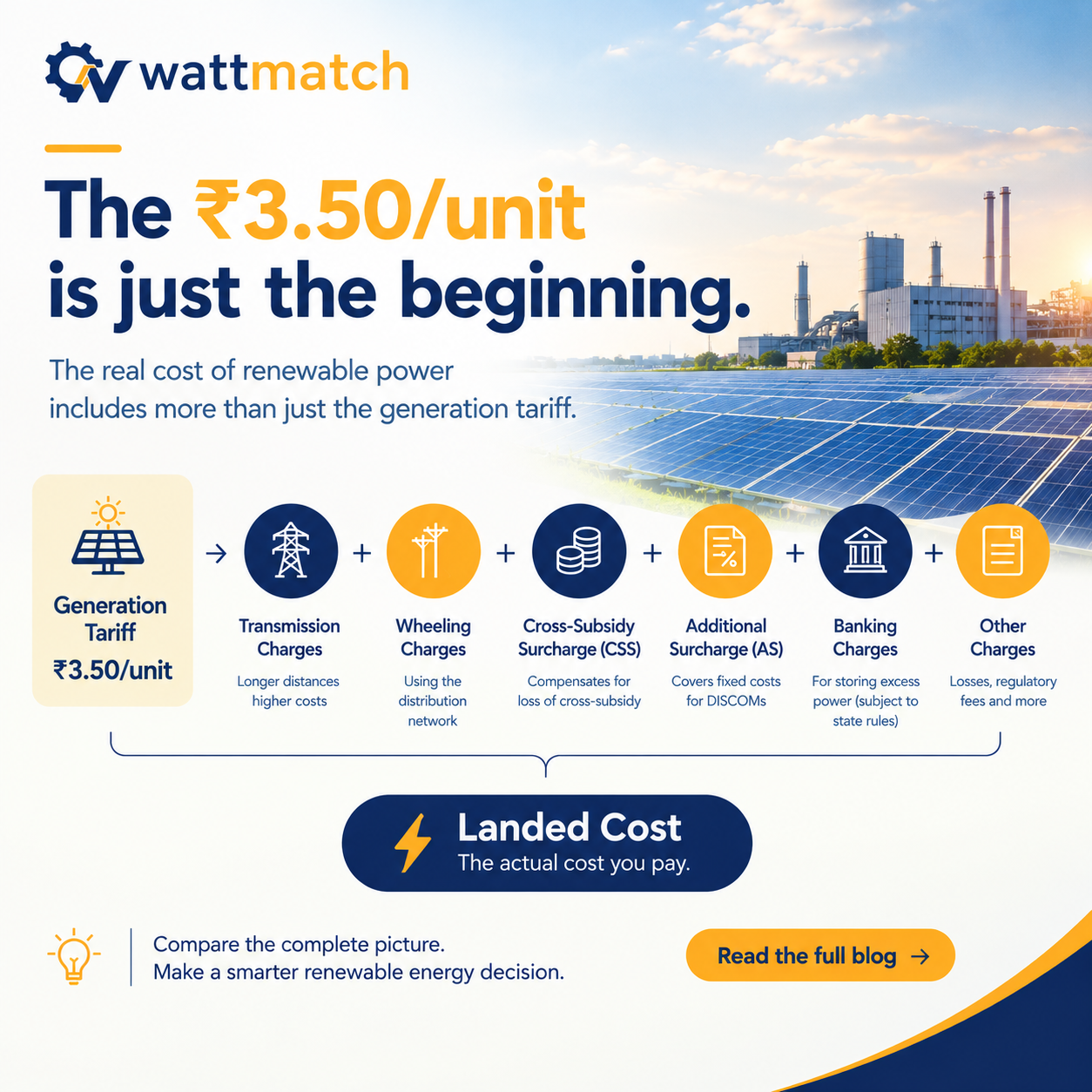
For a C&I business evaluating renewable energy, the first number that usually gets attention is the tariff.
A solar generator may quote ₹3.50 per unit. Another may offer ₹3.70. A third may come in at ₹3.40.
The natural reaction is to compare the three numbers and ask which generator is offering the cheapest power.
But that comparison can be misleading.
A C&I buyer does not ultimately pay the generator's quoted generation tariff alone. Once electricity moves from a renewable energy plant to a factory, warehouse, office, data centre or other commercial facility through the grid, several additional charges can come into the picture.
There can be transmission charges. There can be wheeling charges. Depending on the procurement structure and state, there can be Cross-Subsidy Surcharge (CSS), Additional Surcharge (AS), banking charges and other applicable costs.
The result is an important distinction that every business considering open access renewable energy needs to understand:
The generation tariff is not the same thing as the landed cost of electricity.
And when a company is making a 15–25 year renewable energy procurement decision, understanding that difference is far more important than finding the lowest number on a generator's initial quotation.
The ₹3.50 Question
Imagine an industrial company currently buying electricity from its DISCOM at a significantly higher effective rate.
A renewable energy developer approaches the company with a solar project and quotes:
₹3.50/unit
At first glance, the economics appear compelling.
But ₹3.50 is generally the price of generation. It does not automatically represent the complete cost of getting that electricity to the buyer.
The renewable energy plant may be located hundreds of kilometres away. The electricity needs to be injected into the grid, transmitted and wheeled to the consumer. The buyer may also be subject to state-specific surcharges and other regulatory charges.
So the relevant calculation is not:
Renewable tariff = ₹3.50/unit
It is closer to:
Renewable tariff + applicable transmission and wheeling costs + applicable surcharges + other charges = landed cost
That landed cost is the number that should ultimately be compared with the buyer's existing cost of electricity.
This distinction sounds simple, but it is one of the most important concepts in C&I renewable energy procurement.
It is also why a proper Open Access solar tariff comparison should look beyond the generator's quoted generation tariff.
What Exactly Is Landed Cost?
In simple terms, landed cost is the effective cost of renewable electricity at the point where the C&I consumer receives it, after accounting for the different costs associated with transporting and delivering that electricity.
The generation tariff is therefore just the starting point.
A simplified representation is:
Landed Cost = Generation Tariff + Transmission Charges + Wheeling Charges + Applicable Surcharges + Banking/Other Applicable Charges
The actual calculation is more nuanced because the charges, exemptions, losses and regulatory treatment depend on the state, project location, consumer category, procurement structure and prevailing regulations.
This is why a renewable energy quotation cannot be evaluated in isolation.
A ₹3.50/unit solar tariff in one situation may produce attractive economics, while the same ₹3.50/unit tariff in another situation may not be nearly as compelling.
The difference can come entirely from what sits around the generation tariff.
For a C&I buyer, this makes the difference between DISCOM tariff vs Open Access solar tariff an important part of the procurement evaluation—not simply a comparison between two headline numbers.
Why Does Open Access Have Additional Charges?
To understand this, it helps to understand how electricity physically reaches a C&I consumer.
A renewable energy generator produces electricity at its solar or wind project. That electricity is injected into the shared electricity grid.
The grid is not owned by the generator or the buyer. It consists of transmission and distribution infrastructure operated by different entities.
High-voltage transmission networks move electricity over longer distances, while distribution networks eventually deliver electricity to the consumer.
When a C&I customer buys electricity from a generator other than its local DISCOM, it is effectively using this shared infrastructure to move electricity from the generator to the point of consumption.
That is the fundamental reason open access transactions involve network-related charges.
The consumer is not building a private transmission line from a solar plant to its factory.
It is using the existing electricity system.
And that usage has a cost.
The Different Components of the Open Access Charge Stack
The exact charge stack differs from state to state, but there are several components that C&I buyers should understand.
1. Generation Tariff: Where the Quotation Starts
The generation tariff is the price charged by the renewable energy generator for the electricity produced by the project.
For utility-scale solar, generation tariffs can be considerably lower than the final tariff a C&I consumer sees because utility-scale auction prices and C&I open access prices are not directly comparable.
The WattMatch knowledge base puts indicative utility-scale solar generation tariffs around ₹2.20–2.80/unit, while C&I open access solar may land around ₹4–6.5/unit after applicable charges.
These are broad reference ranges, not quotations. Actual economics depend heavily on the state, project, structure and prevailing regulatory framework.
This is why comparing a utility-scale auction tariff directly with a C&I electricity bill can lead to the wrong conclusion.
The former is a generation price.
The latter reflects the cost of delivering and consuming electricity.
2. Wheeling Charges: Paying to Use the Distribution Network
Once renewable electricity is generated, it has to travel through the electricity network to reach the consumer.
Wheeling charges are associated with using the distribution infrastructure for this purpose.
Indicatively, the WattMatch knowledge base places wheeling charges in a broad range of approximately ₹0.25–1.55/unit, although actual charges vary by state and regulatory order.
Consider the impact at scale.
A business consuming 20 million units of electricity annually would see a ₹0.50/unit difference translate into:
₹1 crore per year.
This is why seemingly small differences in per-unit charges can become material for large C&I consumers.
3. Transmission Charges: The Cost of Moving Power Over Distance
Transmission infrastructure operates at higher voltages and is used to move electricity across larger distances.
When a renewable project and a C&I consumer are connected through the transmission network, transmission charges may apply.
The indicative range in the WattMatch knowledge base is around ₹0.25–0.70/unit.
Again, the exact number matters less than understanding the principle:
A low generation tariff does not necessarily mean a low delivered tariff.
The physical distance and network through which electricity travels can influence the economics of the transaction.
4. Cross-Subsidy Surcharge: One of the Biggest Variables
For many C&I buyers, Cross-Subsidy Surcharge—or CSS—is one of the most important charges to understand.
DISCOM tariffs in India are structured across different consumer categories. Some categories pay more than the underlying cost of supply, effectively helping subsidise other categories.
When an eligible consumer moves away from conventional DISCOM supply and purchases electricity through open access, the DISCOM can lose some of that cross-subsidy contribution.
CSS is designed to compensate for that impact.
Indicative CSS can range from approximately ₹0.20 to ₹2.50/unit, depending significantly on the state and consumer circumstances.
That is a very wide range.
And it demonstrates exactly why the question:
"What is your solar tariff?"
is incomplete.
A better question is:
"What is the generation tariff, what charges will apply to my consumption, and what will the final landed cost be?"
For businesses evaluating Cross-subsidy surcharge Open Access solar, this component can materially affect the overall economics of the procurement structure.
5. Additional Surcharge: Another Cost That Can Affect the Economics
Additional Surcharge, commonly referred to as AS, is intended to account for certain fixed costs that a DISCOM may continue to incur when consumers shift part of their electricity demand to open access.
Indicative Additional Surcharge in the WattMatch reference framework ranges from around ₹0.10–0.80/unit.
The important point for a buyer is that CSS and AS should not be treated as universal, fixed numbers.
Their applicability and level depend on the regulatory framework governing the transaction.
That means the same renewable energy project can produce different landed economics for different customers.
6. Banking Charges: When Generation and Consumption Don't Happen Together
Solar generation has an obvious limitation: it happens during the day.
A factory, however, may operate across multiple shifts. A commercial facility may consume electricity in the evening. A data centre may have a continuous load.
Banking has historically helped address this mismatch in some markets.
Broadly, banking allows surplus renewable generation to be injected into the grid and electricity to be drawn later, subject to applicable state rules.
But banking is not necessarily free.
Indicative banking charges can be around 2–6% of banked units, although the exact mechanism differs by state.
More importantly, banking rules themselves are evolving.
Some states are tightening the conditions under which electricity can be banked and withdrawn. Maharashtra, for example, introduced same-slot banking provisions in 2025, restricting drawal to the same time slot in which electricity was banked.
That has broader implications for C&I procurement.
If a business previously relied heavily on solar + banking to bridge the gap between daytime generation and evening consumption, changes to banking rules can alter the economics of that model.
It can make wind-solar hybrids, storage and other firming solutions more relevant.
For C&I buyers, understanding the banking of power policy for C&I solar is therefore an important part of evaluating the long-term economics of an open access arrangement.
Why the State Matters More Than Most Buyers Realise
One of the defining characteristics of India's electricity market is that renewable energy procurement does not operate under one uniform national commercial framework.
The central regulatory framework provides the broader structure, but state-level regulators determine many of the charges and operational conditions that directly affect C&I consumers.
Wheeling charges, CSS, Additional Surcharge, banking provisions and approval processes can vary significantly from one state to another.
This creates a situation where two companies with almost identical electricity consumption can receive very different renewable energy economics.
Consider two manufacturing companies:
Both consume 10 million units annually.
Both have similar load profiles.
Both receive a solar generation tariff of ₹3.50/unit.
If Company A operates in a state with favourable open access charges and Company B operates in a state with substantially higher applicable surcharges, their final landed costs may be very different.
The generator has not necessarily changed.
The solar plant has not necessarily changed.
The regulatory environment has.
This is why renewable energy procurement needs to be evaluated at the state and consumer level, rather than simply at the national tariff level.
Open Access vs Captive: Why the Structure Matters
There is another reason why looking only at the generation tariff can be misleading.
The procurement structure itself can change the charge stack.
In a conventional third-party open access arrangement, the consumer purchases electricity from a generator without owning the generating asset.
Captive and group captive arrangements work differently.
Under the applicable captive framework, consumers have an ownership interest in the generating project and must meet prescribed ownership and consumption conditions.
One of the major economic advantages is that qualifying captive consumers are generally exempt from CSS and Additional Surcharge in most states.
The WattMatch knowledge base notes that this can commonly make captive power around ₹1.50–2.00/unit cheaper than an equivalent third-party open access PPA, although the actual economics depend on the project and state.
But that does not automatically make captive the right choice for every business.
The buyer has to consider:
- Equity investment
- Capital lock-in
- Ownership structure
- Consumption requirements
- Long-term commitment
- Group captive partner requirements
- Regulatory compliance
So the question is not simply whether captive has a lower tariff.
The question is whether the overall economics justify the additional ownership and structuring requirements.
The Cheapest Generator May Not Offer the Cheapest Power
This is perhaps the most important lesson for a C&I buyer.
Suppose three generators submit the following offers:
| Generator | Generation Tariff |
|---|---|
| Generator A | ₹3.40/unit |
| Generator B | ₹3.55/unit |
| Generator C | ₹3.70/unit |
It would be tempting to select Generator A immediately.
But now add the rest of the picture.
Generator A's project might be located in a configuration with higher transmission and wheeling costs.
Generator B may have a slightly higher generation tariff but a more favourable delivery configuration.
Generator C might offer a captive structure that eliminates certain surcharges.
The cheapest generation tariff may therefore not result in the cheapest landed electricity.
This is why C&I renewable procurement should compare complete commercial offers, rather than just the first number presented by a developer.
A proper Open Access solar tariff comparison should account for the entire charge stack and the buyer's specific consumption profile.
Why This Matters Even More for Long-Term PPAs
A renewable energy procurement decision is rarely a short-term purchase.
C&I PPAs can run for 15–25 years.
That means the buyer is not simply choosing today's electricity tariff.
The buyer is entering into a long-term relationship with a generator and committing to an electricity procurement structure whose economics can be influenced by regulations, network charges, generation performance and the buyer's own consumption profile.
A difference of ₹0.20/unit may look insignificant when viewed against a single electricity bill.
Over millions of units and many years, it becomes a significant commercial number.
This is why a proper evaluation should look beyond:
"What is the tariff today?"
and instead ask:
"What is the expected landed cost over the life of the arrangement, and what assumptions does that calculation depend on?"
This is particularly important when evaluating an industrial solar power purchase agreement, where the commercial relationship can extend over many years.
The Generation Profile Matters Too
Landed cost is not purely a financial calculation.
It also needs to be evaluated against when the business actually consumes electricity.
A solar plant may offer an attractive tariff, but if the buyer's demand is concentrated during evening and nighttime hours, the business needs to understand how that mismatch will be handled.
Possible approaches include:
- Solar + banking, where permitted
- Wind-solar hybrid
- Solar + BESS
- Firm and Dispatchable Renewable Energy (FDRE)
- A combination of renewable procurement structures
The right choice depends on the load profile.
A single-shift factory with significant daytime consumption may find solar particularly attractive.
A 24×7 industrial operation may need a more sophisticated renewable energy mix.
This is why tariff and load profile need to be evaluated together.
What Should a C&I Buyer Ask a Renewable Energy Generator?
Before comparing two renewable energy proposals, a buyer should be able to answer a few basic questions.
About the Tariff
- What is the quoted generation tariff?
- Is the tariff fixed or subject to escalation?
- What is included and excluded from the quoted price?
About Delivery
- Where is the renewable energy project located?
- Is the transaction intra-state or inter-state?
- What transmission and wheeling charges apply?
- What losses need to be considered?
About Surcharges
- What CSS applies?
- Does Additional Surcharge apply?
- Are there any applicable exemptions?
- Would a captive or group captive structure change the economics?
About Banking
- Is banking available in the relevant state?
- What are the current banking charges?
- What are the restrictions on banking and withdrawal?
- Could changes to banking rules affect the expected economics?
About the Buyer's Consumption
- How much electricity does the business actually consume?
- What percentage of consumption occurs during solar generation hours?
- Is the buyer a single-shift or multi-shift operation?
- Is storage or hybrid generation necessary?
About the Contract
- What is the PPA tenure?
- What are the performance obligations?
- What happens if the project underperforms?
- How are regulatory changes handled?
- What are the termination and payment-security provisions?
These questions help turn a simple tariff comparison into a proper procurement assessment.
What a Good Renewable Energy Comparison Should Actually Look Like
For a C&I business, the ideal comparison should not be a table that simply says:
| Generator | Generation Tariff |
|---|---|
| Generator A | ₹3.40/unit |
| Generator B | ₹3.55/unit |
| Generator C | ₹3.70/unit |
It should look more like:
| Component | Generator A | Generator B | Generator C |
|---|---|---|---|
| Generation tariff | — | — | — |
| Transmission | — | — | — |
| Wheeling | — | — | — |
| CSS | — | — | — |
| Additional Surcharge | — | — | — |
| Banking | — | — | — |
| Losses/other charges | — | — | — |
| Landed cost | — | — | — |
Only then does the buyer have a meaningful basis for comparison.
And even this is not the entire decision.
The buyer should also consider the generator's technical and financial credibility, project location, generation profile, PPA terms and long-term ability to deliver.
The Role of Price Discovery in Making Renewable Procurement More Transparent
This is where the procurement process itself becomes important.
Traditionally, many C&I renewable energy transactions are negotiated bilaterally.
A buyer may speak to one developer, receive a quotation, negotiate, and eventually decide whether the offer is attractive.
The problem is that the buyer may not know whether the quoted tariff is actually competitive.
Is ₹3.50/unit a good price?
Would another developer offer ₹3.30?
Would a different project structure produce a lower landed cost?
Would a captive arrangement be more economical?
Without sufficient price discovery, these questions can be difficult to answer.
A competitive procurement process changes the equation by allowing multiple qualified generators to compete for the same requirement.
But competition only works if the proposals are comparable and the generators are credible.
That means price discovery needs to be combined with technical and financial due diligence, standardised contracting and a clear understanding of the applicable charge structure.
This is precisely the gap that structured procurement platforms can help address.
WattMatch's model combines generator vetting, competitive bidding and standardised contracting so that C&I buyers can evaluate renewable energy offers on a more comparable basis.
The Real Question Isn't "How Cheap Is the Solar?"
It is tempting to think of renewable energy procurement as a search for the cheapest solar tariff.
But for a C&I business, that is too narrow a way to look at the decision.
The real question is:
What is the most competitive, reliable and commercially viable renewable electricity solution for my specific load, location and requirements?
That requires looking at the complete picture:
Generator tariff → Transmission → Wheeling → Surcharges → Banking → Losses → Landed Cost → Load Profile → Contract Terms
Only then can a business make a meaningful comparison with its current grid power.
From a ₹3 Tariff to a Real Business Case
India's C&I renewable energy market has matured significantly. Open access has expanded, renewable generation costs have become increasingly competitive, and more businesses are actively looking to reduce both their electricity costs and their carbon footprint.
But as adoption grows, the challenge is no longer simply finding renewable energy.
It is finding the right renewable energy deal.
A C&I buyer needs to know what it is actually paying for every unit, which charges are included, which are additional, how the state regulatory framework affects the transaction, and whether the proposed structure is appropriate for its load.
The headline tariff is only the beginning of that conversation.
The real number is the one that lands on the buyer's books.
In renewable energy procurement, the cheapest tariff isn't necessarily the cheapest power. The right comparison is always the landed cost.
How WattMatch Helps
WattMatch brings C&I buyers and renewable energy generators onto a structured procurement platform, enabling buyers to compare offers from vetted generators rather than relying on a single bilateral quotation.
The objective is simple: make renewable energy procurement more transparent, competitive and easier to navigate—from price discovery and generator vetting to contracting and long-term relationship management.
For a C&I business evaluating renewable power, the starting point should not be:
"Who is offering me the lowest tariff?"
It should be:
"What will my renewable electricity actually cost—and what am I getting for that cost?"